One of the most common questions procurement teams ask Indonesian furniture suppliers is about MOQ. What’s the minimum? Is a full container required? Can smaller projects be served at all? There is no single answer, but there is a useful framework. What follows is a Q&A for boutique hospitality buyers trying to figure out whether their project shape fits with Jepara workshop suppliers, or whether a different sourcing model makes more sense.
What is the typical minimum order quantity for hospitality furniture from Jepara?
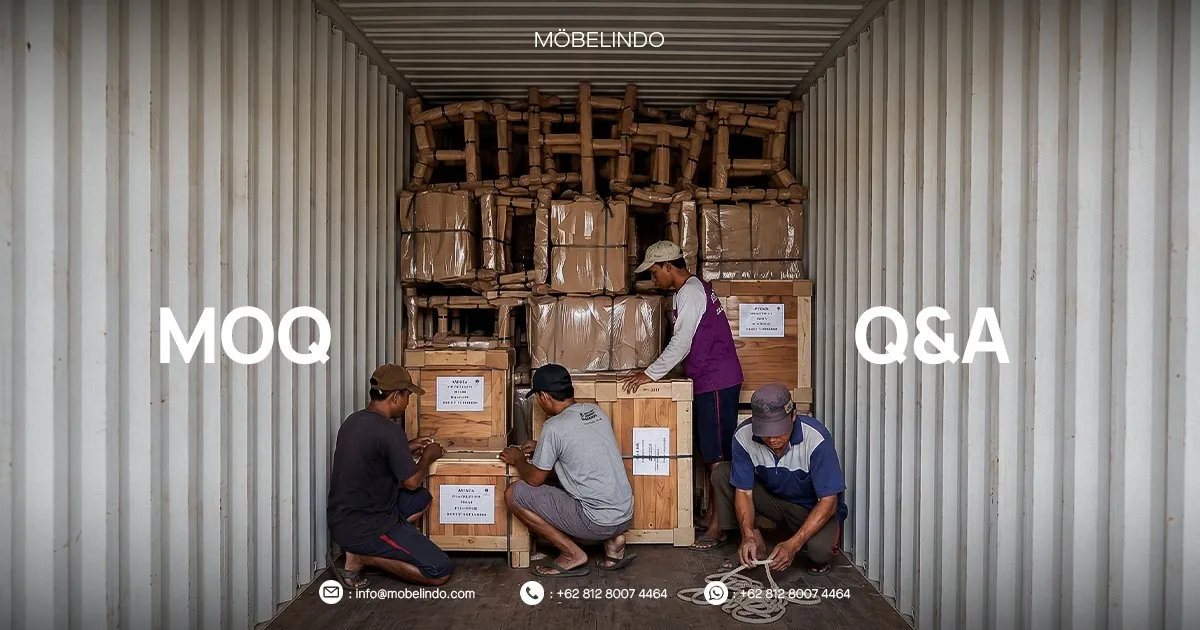
For solid wood hospitality furniture from Jepara workshops, MOQ is typically defined by container economics rather than by piece count. One 20-foot container is a common practical minimum for boutique hospitality projects, though smaller consolidated orders are possible through Less than Container Load shipping.
The reason for this framing is that hospitality furniture from Jepara is almost always destined for international shipment. Once a project crosses that threshold, the economics of ocean freight, customs clearance, and packing labor start to dominate the conversation. Suppliers who quote MOQ purely in piece count are usually skipping over the freight math, which tends to catch buyers off guard later in the process.
A 20-foot container holds approximately 30 cubic meters of usable space when packed for furniture. A 40-foot high-cube container holds approximately 65 to 68 cubic meters. Translated into hospitality terms, a 20-foot container carries roughly 15 to 20 complete guest room furniture sets, depending on spec. That aligns naturally with a 20 to 40 room boutique property, which is why boutique hotels and small resorts tend to be the sweet spot for Jepara workshop suppliers.
Smaller projects are not excluded from Jepara sourcing, but they require different logistics thinking, which is covered in later sections of this article.
Why does MOQ depend on container shipping economics?
Ocean freight is priced by the container, not by the weight or piece count inside it. This single fact drives most of the MOQ conversation for international furniture procurement, and understanding it saves buyers from surprises in the quote stage.
Here is the practical implication. When a supplier ships a 20-foot container at half capacity, the fixed costs of shipping (ocean freight, port fees, customs clearance, packing labor, container reservation) still apply as if the container were full. Somebody absorbs those costs. Either the supplier bakes them into inflated unit pricing to protect their margin, or the supplier absorbs them and takes a loss on the project. Neither outcome is sustainable, which is why most Jepara workshops decline to ship substantially underfilled containers.
The math typically breaks down like this. At 100 percent container utilization, the ocean freight cost per piece for average boutique guest room casegoods runs roughly 8 to 12 percent of the FOB piece price. At 50 percent utilization, the same per-piece freight cost jumps to 16 to 24 percent of the piece price. At 30 percent utilization, it approaches 25 to 40 percent. These are approximate figures and vary by destination, but the pattern is consistent.
For procurement teams, the practical takeaway is that MOQ conversations with Jepara suppliers are less about “will you accept my small order” and more about “does the shipping math still work for both sides at this order size.” Suppliers who can articulate this math openly tend to be the ones worth working with.
Can I order less than a full container and consolidate with other buyers?
Yes. Less than Container Load shipping is available for most destinations, and buyer consolidation through the supplier or through third-party freight forwarders is a workable option for smaller projects. Both add complexity, and both come with tradeoffs worth understanding before committing.
- LCL shipping allows a buyer to book only the cubic meters of space they need within a shared container. The freight forwarder consolidates cargo from multiple shippers, loads them into a single container, and each buyer pays for the space they used plus a share of handling costs. LCL rates run roughly 30 to 50 percent higher per cubic meter than FCL (Full Container Load), but for a small project needing 8 or 10 cubic meters of furniture, the total cost is still much lower than paying for an underfilled full container.
- Supplier consolidation works when the supplier has another project shipping to the same or a nearby destination in a compatible timeframe. In this arrangement, two or more buyers share a container coordinated by the supplier. This tends to work best when buyers are flexible on delivery timing, since the shipment waits until both projects are ready to load.
- Buyer-side consolidation happens when procurement teams or designers coordinate across multiple client projects to build to a full container. This is more common than most buyers realize, particularly in the boutique hospitality segment where design firms often manage multiple properties simultaneously.
The tradeoffs are transit predictability and delivery timing. LCL and consolidation shipments have longer and less predictable transit times than FCL. For a boutique property with a firm opening date, this is worth discussing at the supplier qualification stage rather than at the last minute.
What is a realistic MOQ for solid teak case goods, by piece count and dollar value?
For solid teak boutique hospitality case goods, a workable minimum is typically one 20-foot container equivalent. That translates to roughly 60 to 120 pieces of average boutique case goods (wardrobes, desks, side tables, headboards, benches), with a total invoice value in the USD $30,000 to $60,000 range.
The wide range reflects real variability in project specification. A boutique guest room set consisting of one wardrobe, one desk with chair, two nightstands, one headboard, and one luggage bench occupies roughly 1.5 to 2 cubic meters when packed. A 20-foot container of 30 cubic meters usable space therefore carries roughly 15 to 20 complete guest room sets. Multiply that by average FOB piece pricing for solid teak case goods, and you arrive at the invoice range above.
For a 40-foot high-cube container, the same math roughly doubles. Total capacity of 65 to 68 cubic meters carries 32 to 44 complete guest room sets, at an invoice value of roughly USD $65,000 to $130,000.
These figures assume solid teak plantation stock from Perhutani, standard workshop-grade finishing, and boutique-appropriate design complexity. They shift meaningfully for more elaborate specifications. A wardrobe with intricate hand-carved detail or an oversized headboard with reclaimed teak inlay can occupy significantly more space per piece and carry a higher per-piece cost, which changes both the piece count and the invoice value in the same container.
Suppliers who quote firm MOQs without asking about specification complexity, average piece size, and finish detail are working from templates rather than from actual production math. Better to work with suppliers who ask before they answer.
How does MOQ change when ordering upholstered furniture versus case goods?
Upholstered furniture typically carries higher MOQ requirements than solid wood case goods, because of fabric ordering minimums, foam batch sizes, and the workflow-heavy nature of upholstery production.
- Fabric MOQ is often the constraining factor. When a buyer specifies COM (Customer’s Own Material) fabric, the minimum roll purchase from most hospitality-grade fabric mills is 30 to 50 running meters per color and pattern. That volume of fabric covers roughly 40 to 80 dining chairs or 15 to 25 lounge chairs depending on the piece size and coverage requirements. Below that piece count per fabric SKU, the fabric ordering economics stop working.
- Foam and filling materials come in batch minimums as well. Cutting a foam order below batch size means paying the batch cost anyway, which pushes per-piece cost up quickly. For upholstered dining chairs, the practical minimum for economical foam sourcing is typically 100 to 150 pieces per foam profile.
- Production setup for upholstery is workflow-heavy rather than piece-heavy. A workshop upholstery line takes similar setup time whether producing 50 pieces or 250 pieces of a given design. This means small upholstery runs carry high fixed cost per piece.
The practical implication for boutique hospitality is that projects mixing case goods and upholstered pieces often benefit from staggered MOQ planning. Case goods can proceed at one container’s worth of quantity. Upholstered pieces may need to be ordered in slightly higher quantities per style, or the mix of styles narrowed to consolidate volume. A supplier who walks the buyer through this tradeoff openly is showing the kind of project planning discipline that pays off later.
For solid wood lounge chairs or dining chairs with removable COM cushions, the frame MOQ and the cushion MOQ can sometimes be handled separately, giving the buyer more flexibility. This is worth asking about specifically during specification.
What if my project is smaller than typical MOQ, what are my options?
For projects below typical MOQ thresholds, three practical options exist: LCL shipping with adjusted expectations on cost and timeline, batching with other projects to build toward a full container, or reconsidering the sourcing model entirely.
- LCL shipping is the most common path for small boutique projects. It works well for orders in the 8 to 20 cubic meter range, where paying LCL premium rates still results in a lower total cost than either paying full container overhead or shipping in unrealistic quantities. Buyers should build the LCL cost premium into their quote comparisons rather than being surprised by it later.
- Project batching works when a buyer has visibility to multiple upcoming projects at similar spec. Coordinating orders across two or three projects to build container volume is common in boutique hospitality design practice, particularly when a single design firm serves multiple clients with related aesthetics.
- Specification consolidation can also shift a project into full container range. Some projects start with a narrow scope (guest room casegoods only) and expand to include public area furniture, bar seating, or spa pieces to fill container capacity. This is a legitimate procurement strategy when it aligns with actual project needs, and it often improves total project economics.
- Reconsidering the sourcing model is the honest option for very small projects. For a five-room boutique villa or a 10-room guesthouse, sourcing entirely from Jepara may not be the right structural fit. Local sourcing near the property, regional consolidation through a distributor with existing inventory, or a mixed strategy (Jepara for signature pieces, local for volume) can be more practical.
The suppliers worth working with in this scenario are the ones who will tell you if your project is not the right fit for them. That honesty is rare, but it saves everyone time.
Four Procurement Scenarios with Realistic MOQ Ranges
To translate the framework into practice, four common boutique hospitality scenarios and how MOQ typically works for each.
- Scenario 1: Small boutique villa (5 to 10 units). Approximate FF&E volume of 8 to 15 cubic meters. MOQ path is typically LCL shipping or supplier consolidation with another project. Approximate FOB invoice range of USD $8,000 to $22,000 for guest room casegoods essentials. For this scale, the sourcing conversation is often as much about whether Jepara is the right structural fit as it is about specific MOQ numbers. Worth exploring both Jepara and local sourcing at this scale.
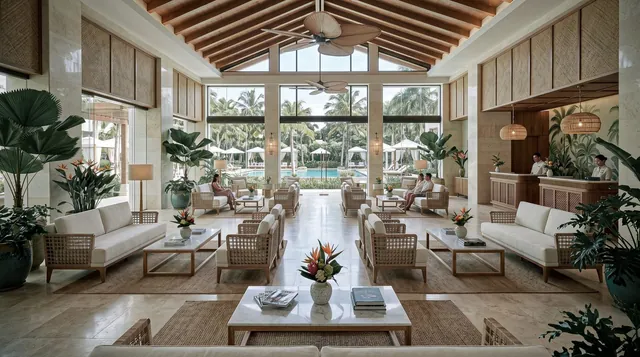
- Scenario 2: Boutique hotel (20 to 40 rooms). Approximate FF&E volume of 30 to 50 cubic meters. MOQ path is typically one 20-foot container or one 40-foot container FCL. Approximate FOB invoice range of USD $30,000 to $90,000 depending on spec detail and finish complexity. This is the natural sweet spot for Jepara workshop suppliers, where the container math works cleanly and the workshop model offers flexibility without capacity constraints.
- Scenario 3: Mid-size boutique resort (60 to 100 rooms). Approximate FF&E volume of 90 to 150 cubic meters. MOQ path is typically two to three 40-foot containers, often shipped in staged deliveries to align with the property construction schedule. Approximate FOB invoice range of USD $180,000 to $450,000. At this scale, phased shipment and payment schedules become part of the procurement conversation, and the supplier’s operational capacity to sustain multi-container production over several months matters more than piece MOQ.
- Scenario 4: Chain hotel or larger branded property (150 plus rooms). Approximate FF&E volume of 200 cubic meters or more. MOQ path is typically a series of FCL shipments with dedicated production lines. Approximate FOB invoice range of USD $400,000 and up. At this scale, workshop model suppliers may face capacity constraints, and the buyer should evaluate whether a factory-model supplier or a coordinated workshop network is the better structural fit.
A Closing Note
MOQ conversations are, at their heart, conversations about whether the shipping math works for both sides of the transaction. Suppliers who frame MOQ as a fixed rule are usually skipping the math. Suppliers who frame it as a conversation about your project scale, specification mix, and delivery timing are usually the ones worth working with.
If you are mapping your project against these scenarios and want to talk through your specific specification, my DMs are open. No pitch, no obligation. Just a conversation with someone who has been on the manufacturer side of these decisions for a while.