





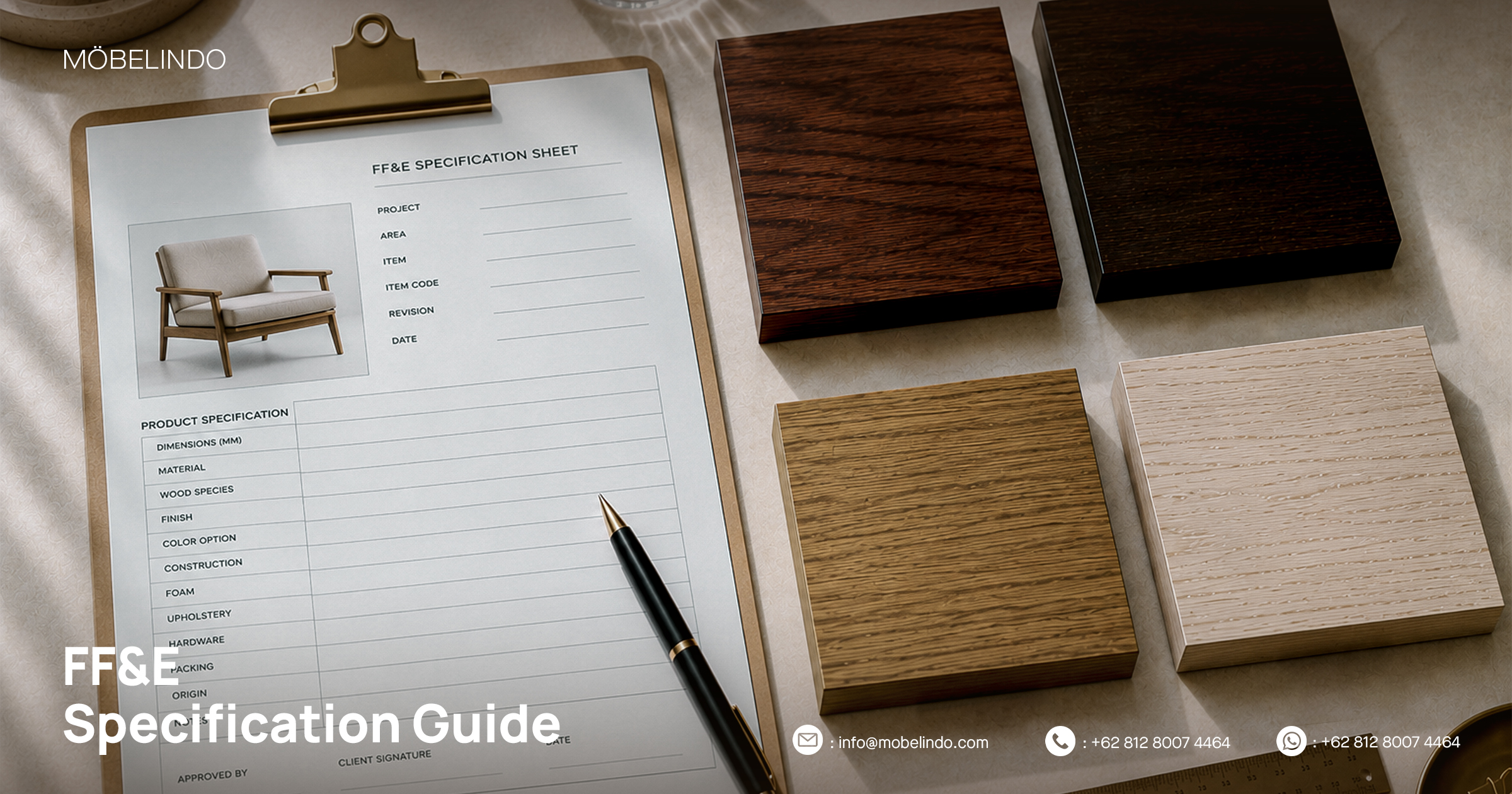
One of the highest leverage decisions in a boutique hotel opening timeline is the FF&E specification phase. Getting this right early prevents 6 to 18 month cascading issues. A practical Q&A for hospitality operators, owners, and procurement leads planning openings in 2026 to 2027.
Opening a boutique hotel is a race against a fixed date. The doors open when they open, and every supplier in the chain has to land on time. Among all the decisions that shape that timeline, one of the highest leverage moments is FF&E specification. FF&E stands for Furniture, Fixtures, and Equipment: the loose furniture, casegoods, lighting, and soft furnishings that turn a finished shell into a place guests actually want to stay in.
Get the specification right early and you protect the entire downstream schedule. Leave it vague or late and small gaps compound into 6 to 18 month problems: re-quotes, repeated sampling, reordered timber, and shipping windows that slip past your opening.
Below are the questions we hear most often from owners and procurement leads, answered directly.
How early should FF&E specification start relative to the target opening date?
For custom or made-to-order pieces, start FF&E specification roughly 12 to 14 months before your target opening. That may sound early, but solid timber furniture has a long runway. Timber needs to be kiln-dried and acclimatized, joinery takes time, finishing and sampling add weeks, and sea freight from Southeast Asia to most markets runs several weeks on top of production. You also want a buffer for one round of revisions and for customs clearance at the destination.
If your scope leans toward contract-standard or ready pieces, you can compress this. But boutique usually means bespoke, and bespoke rewards an early start. The single most common cause of a delayed opening we see is a specification that was finalized two or three months too late.
What is the minimum specification level needed to request accurate quotes?
To get a quote you can actually rely on, a maker needs enough detail to price material, labor, and finish without guessing. A mood board alone gets you a ballpark, not a firm number.
At minimum, provide:
- Dimensions for each item (width by depth by height)
- Material and timber species per component
- Finish type and sheen level
- Upholstery details where relevant (fabric grade and foam)
- Quantity per item, and your target MOQ
- Destination market, which affects packing, finish, and compliance
Reference drawings or CAD files sharpen the quote further and reduce back-and-forth. The clearer the brief, the closer the quote will be to the final invoice.
How do you specify solid teak grades for different areas of a boutique hotel?
Match the grade to the exposure and the sightline. You rarely need one grade for the whole property.
Premium or clear grade, with uniform color and minimal knots, suits your hero and close-contact pieces: reception desks, headboards, dining tables, anything guests look at from a foot away. Character grade, with natural color variation and small sound knots, works beautifully for outdoor furniture, terraces, and high-turnover areas, where that variation reads as warmth and authenticity while keeping cost sensible.
Ask your maker about the source too. Plantation teak from managed forestry gives you a traceable, legal supply, backed by SVLK (Sistem Verifikasi Legalitas Kayu, Indonesia’s Timber Legality Assurance System). And confirm that timber is kiln-dried and acclimatized before joinery, since that is what keeps a piece stable across seasons rather than any single number on a spec sheet.
What upholstery specifications matter most for hospitality longevity?
In contract (commercial) settings, upholstery almost always wears out before the frame does. Specify it for three things: abrasion, cleanability, and fire safety.
Abrasion resistance is measured by the Martindale test, expressed as a rub count. Contract-grade fabrics carry far higher counts than residential ones, so ask for the figure rather than the look alone. For the fill, foam density and resilience decide whether a seat keeps its shape after a year of daily use. Specify removable or zippered covers wherever you can, because they make cleaning and future reupholstery far cheaper than replacing whole pieces.
Finally, upholstery often has to meet the flammability rules of the destination market, and those rules vary by country. Confirm the applicable standard before you order, and ask your supplier for the supporting documentation in writing.
How do you specify finish for coastal, dry, and temperate destinations?
Specify finish by the climate the piece will live in, because timber moves with humidity and coatings behave differently by exposure.
For coastal and high-humidity locations, prioritize moisture management and corrosion-resistant hardware such as stainless fittings. Outdoor teak can either be left to silver naturally or maintained with periodic oiling, so decide the look you want and write the maintenance expectation into the spec. One honest caution: a waterbased interior coating is durable indoors, but it is not an exterior or marine system and should not be specified as one. Always ask exactly what a coating is rated for.
For dry climates, the risk is checking or cracking from low humidity, so proper acclimatization and sound joinery matter most. Temperate destinations are the most forgiving and accept standard interior finishes. In every case, tell your maker the destination up front, since it changes both the finish choice and the packing.
What documentation should the specification package include?
A complete specification package removes ambiguity, which means every quote you receive is pricing the same thing. That alone makes bids comparable and negotiations faster.
A strong package includes:
- An item schedule: a full list of every piece with its quantity
- A spec sheet per item covering dimensions, materials, finish, and upholstery
- Reference drawings or CAD files, and image references for intent
- Finish and fabric samples or clear references
- Quantities and any MOQ per design
- Packing and destination requirements, plus the target delivery date
- Legality and compliance documents relevant to the destination, such as SVLK for timber legality
- Your QC and inspection expectations
Handing this to a maker on day one, rather than assembling it piece by piece during production, is what keeps the schedule intact.
A simple 5-step opening timeline
Counting backward from your opening date, a practical template looks like this:
- 12 to 14 months out: Finalize the FF&E specification and issue it for quotation.
- 10 to 12 months out: Award the order, then approve samples, finishes, and fabrics.
- 6 to 9 months out: Production runs, with quality checks along the way.
- 3 to 5 months out: Final inspection, packing, and shipping.
- 1 to 2 months out: Delivery, installation, and snagging before the doors open.
These are indicative and compress for smaller scopes, but the sequence holds. The earlier your specification is locked, the more of this timeline works in your favor.
Want the specification checklist as a PDF? Email us at [email protected]


0 Comments