





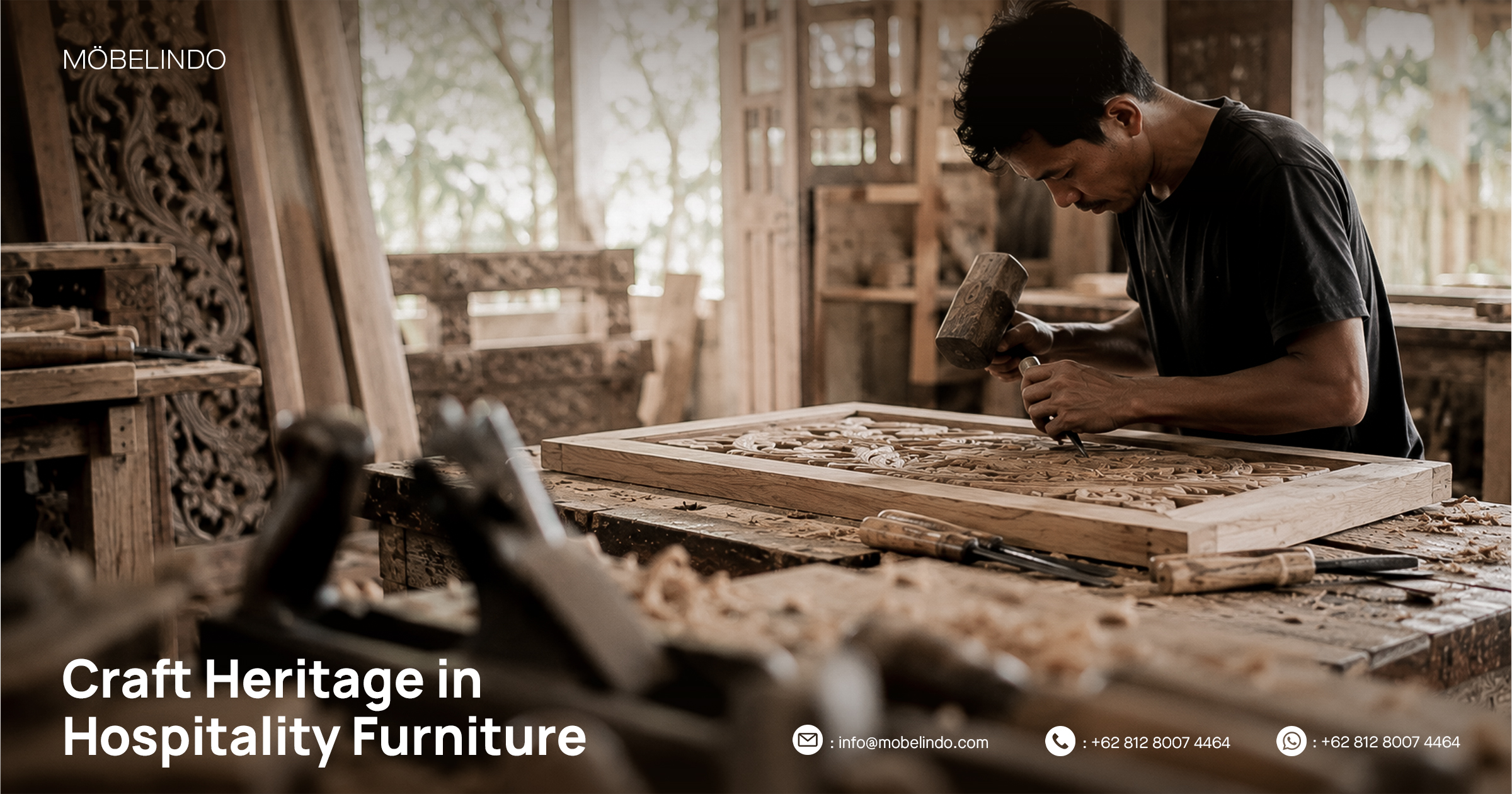
A longer look at Jepara’s ukir tradition and how it shapes contemporary FF&E production.
Boutique hospitality buyers considering Indonesian furniture sourcing often ask about the heritage claims that Jepara suppliers make. Centuries of tradition, generations of skill transfer, the ukir carving lineage. These claims are real, but the version that shows up in marketing copy often oversimplifies a longer and more interesting story. What follows is a look at what Indonesian craft heritage actually means, how the ukir tradition translates into modern hospitality furniture production, and what procurement teams should understand before evaluating heritage as part of a supplier’s positioning.
What is the history of furniture craft in Indonesia?
Furniture craft in Indonesia has roots that go back several centuries, with the strongest documented lineage in wood carving traditions that predate what most people think of as furniture manufacturing.
The historical distinction matters. Wood carving, or ukir in Indonesian, developed early across the archipelago as an ornamental craft serving religious architecture, royal courts, and community structures. Balinese temple carving, Toraja tongkonan house detailing, and Central Javanese court woodwork all represent regionally distinct traditions that developed independently over centuries. These are craft lineages measured in hundreds of years.
Furniture manufacturing as a commercial industry serving external markets is a more recent development. It emerged during the Dutch colonial period, roughly the 17th to 19th centuries, when European demand for tropical hardwood furniture began to reshape traditional carving workshops into export-oriented production. This is a shorter lineage, but still measured in centuries rather than decades.
The distinction is worth making because heritage claims from suppliers sometimes conflate the two. A workshop can genuinely claim to sit within a wood carving tradition that predates furniture manufacturing itself. That workshop’s practice as a furniture producer for hospitality projects is more recent. Both are true, and neither diminishes the other, but the distinction matters when procurement teams evaluate what heritage actually means in practice.
For hospitality FF&E specifically, the useful heritage is not the age of the tradition but the way that tradition informs contemporary practice. Which is what the rest of this article covers.
What is Jepara’s role in Indonesian furniture heritage?
Jepara occupies a specific and important role in Indonesian furniture heritage. It is the district in Central Java where wood carving tradition and export furniture manufacturing developed together over several centuries, producing a workshop ecosystem that today serves both traditional and contemporary hospitality markets.
The ukir tradition in Jepara traces back to the late Majapahit and early Demak Sultanate eras, roughly the 15th to 16th centuries. Historical accounts often reference the patronage of Ratu Kalinyamat, the 16th-century queen of Jepara, whose court supported carving workshops that produced ornamental woodwork for religious and royal use. This is where the deep craft lineage of the region originates.
Over the following centuries, the same ukir workshops adapted to serve colonial-era demand for furniture, then twentieth century export markets, and eventually the international hospitality and residential markets that define much of the region’s output today. Skills passed through family and apprenticeship structures rather than formal institutions, which is why the technical vocabulary of Jepara craftsmanship (specific joinery methods, finishing techniques, ornamental patterns) is often more refined than what you find in newer manufacturing centers.
For a working boutique hospitality supplier in Jepara today, this heritage shows up in three practical ways. Access to a labor pool of skilled woodworkers, finishers, and carvers who trained through apprenticeship in workshops that trace their lineage back several generations. Familiarity with a design vocabulary that draws on centuries of ornamental tradition, which can be selectively incorporated into contemporary hospitality pieces. And an integrated ecosystem of supporting trades (timber suppliers, hardware wholesalers, packaging specialists) that has developed around furniture production over centuries.
None of this makes Jepara the only place in Indonesia where good hospitality furniture is made. It does make Jepara the place where the depth of craft tradition and the depth of manufacturing infrastructure overlap most substantially.
How does traditional craft translate into modern hospitality furniture?
Traditional craft translates into modern hospitality furniture through the transfer of specific skills and design principles from carving and joinery tradition into contemporary production practice, not through the direct reproduction of traditional forms.
The most direct transfer happens in joinery. Traditional Jepara furniture used mortise-and-tenon joints, dovetail construction, wedged connections, and pinned assemblies developed to withstand tropical humidity cycling over decades without failing. These joinery methods are still used in contemporary hospitality pieces where their durability advantages matter, particularly in structural applications and pieces expected to serve long operational lifespans.
The second area of transfer is timber selection knowledge. Craftsmen trained in the ukir tradition learned to read wood grain, density, and moisture behavior by hand and by eye. This tacit knowledge remains valuable in contemporary production, where automated grading systems can measure moisture content but cannot substitute for the judgment of an experienced hand assessing how a specific board will behave in production.
The third area is ornamental vocabulary. Traditional Jepara ukir carries a design language of floral motifs, geometric patterns, and figurative elements that developed over centuries. Contemporary hospitality projects rarely commission full traditional ornamentation, but selective incorporation of carved detail (a subtle motif on a headboard, a carved apron on a table, a hand-shaped drawer pull) can give a boutique piece a sense of place that mass-produced alternatives cannot match. The vocabulary is available. The question is how much and where to apply it.
Where craft tradition does not directly translate is in areas where modern engineering has produced better outcomes. Kiln drying is more precise than traditional air drying and produces more stable pieces. Modern water-based finish systems perform better in air-conditioned environments than traditional shellac. Contemporary hardware (316 stainless steel, soft-close drawer glides) offers durability that traditional wood-on-wood mechanisms cannot match in hospitality use.
The practical result for a well-run Jepara workshop today is craft heritage informed by modern engineering. Traditional joinery where it improves outcomes. Modern methods where they improve outcomes. Not a pure recreation of tradition, and not a rejection of it. A working synthesis.
What can craft-based furniture offer that mass production cannot?
Craft-based furniture production offers three things that mass production structurally cannot match: dimensional and design flexibility at small production volumes, direct human accountability for individual pieces, and the ability to selectively incorporate ornamental detail without retooling.
Dimensional and design flexibility is the most operational difference. A mass production line optimized for repetitive output can produce large volumes of a single design efficiently, but adapting that line to accommodate boutique variations (different dimensions per room, different finishes per section of the property, different detail on hero pieces) requires setup changes that erode the volume efficiency. Craft-based production is built around variation from the start. The same workshop can produce 40 slightly different guest room sets more efficiently than a mass production line can produce 40 identical sets plus 40 variations.
Direct human accountability shows up when something needs to be traced. On a mass production floor with hundreds of workers running identical operations, traceability depends on systems and documentation. On a craft workshop floor with a smaller team where the shop lead knows each project by reference number, traceability is human. When a defect is found at inspection, the person who built the piece can usually be identified in minutes. When a design revision needs to be understood, the person who executed the previous version can walk the change through personally.
Selective ornamental capability is the third structural advantage. A mass production line configured to produce plain casegoods cannot economically add hand-carved detail to hero pieces. A craft workshop that has carvers on staff can incorporate ornamental elements exactly where the design calls for them, without retooling and without changing the pricing structure of the standard pieces in the same order.
The tradeoffs of craft-based production are real too. Craft-scale workshops move more slowly on very high volumes, are more affected by material price volatility, and iterate more carefully on new techniques. For boutique hospitality projects at one to three containers per property with meaningful design variation across the property, the tradeoffs generally work in favor of craft-based production. For chain hotel orders of ten containers or more with standardized specifications across the property, the tradeoffs work against it. Different problems, different production models.
How does traditional craft knowledge show up in modern hospitality furniture production?
Traditional craft knowledge shows up in modern hospitality furniture production in ways that are often invisible in the finished piece but consistently observable in the production process, the material handling, and the depth of the workshop’s technical vocabulary.
The most reliable signal is the ability of the shop lead or founder to speak in specific technical terms about joinery, timber, and finish behavior when asked. Suppliers with genuine craft lineage can walk a procurement team through a piece and describe why a particular joint was chosen for a particular load, why one section of a panel was cut from a specific board, why the finish system was layered in a specific sequence. This depth of explanation cannot be manufactured for a sales call. It reflects years of accumulated practice.
A second signal is the way the workshop handles material selection within an order. Traditional craft practice sorts timber for visual consistency across pieces in a matched set, matches grain patterns across adjacent surfaces on individual pieces, and orients grain direction to minimize seasonal movement. Suppliers who skip this material selection discipline produce room sets where matching pieces visibly disagree six months after installation, regardless of how good the finish system was.
A third signal is the presence of workers with specialized skills that mass production does not require. A carver on staff, a finisher who works by hand between spray coats, a joinery specialist for structural work. These roles exist in workshops with real craft depth. They do not exist in operations that use craft as a marketing frame without operating as one.
For procurement teams evaluating heritage claims, the practical approach is to ask about specific technical practices rather than about the heritage story itself. A workshop with genuine craft lineage will answer specific questions with specific answers. A workshop marketing heritage without the underlying practice will fall back on general claims about tradition and generations of experience.
Both models exist in Jepara and elsewhere in Indonesia. The heritage claim is not what distinguishes them. The practical vocabulary is.
Why does material sourcing matter for craft-based furniture?
Material sourcing matters for craft-based furniture because the physical properties of the timber directly determine what the craft can achieve, and because the sustainability and traceability of the source have become non-negotiable for international hospitality markets.
For solid teak specifically, the credible sourcing options for Indonesian hospitality furniture are plantation teak from Perhutani, the state forestry corporation that manages sustainable teak plantations across Java, and documented reclaimed teak from verified building demolitions. Both are traceable, both meet international export requirements, and both produce timber suitable for hospitality applications when handled correctly.
The reason craft-based production is particularly sensitive to material sourcing is that craft methods rely on the material behaving predictably. Traditional joinery works because the wood species and moisture content have known behavior. Traditional finish systems produce known outcomes when applied to known wood. When material sourcing becomes inconsistent, whether through mixed species, inconsistent drying, or unverified origin, the craft cannot compensate. The joinery loosens, the finish behaves unpredictably, the pieces do not age consistently across a room set.
Beyond the technical dimension, international hospitality markets have increasingly required documented sourcing. The European Union Deforestation Regulation, coming into full enforcement at the end of 2026, will require chain-of-custody documentation for timber components in furniture entering EU markets. The Lacey Act in the United States has required similar documentation for years. Hospitality developers building properties in these markets need suppliers whose material sourcing is documented and defensible, not asserted.
For procurement teams evaluating Indonesian craft-based suppliers, the practical questions to ask about material sourcing include the specific source (Perhutani plantation stock, documented reclaimed, or other verified source), the chain-of-custody documentation available, and the workshop’s process for handling material selection within an order to produce visual consistency across matched pieces.
Craft heritage and material sourcing are two sides of the same practice. A workshop with deep craft lineage but inconsistent material sourcing will produce inconsistent outcomes. A workshop with disciplined material sourcing but shallow craft depth will produce technically adequate but visually flat pieces. The suppliers worth working with have both.
A Closing Note
Indonesian craft heritage, understood accurately, is not a marketing frame. It is a working tradition that stretches back centuries in specific places, most notably Jepara, and that continues to inform how hospitality furniture is made today when the workshop takes the tradition seriously.
For procurement teams considering Indonesian sourcing, the useful question is not how old the tradition is or how many generations the workshop can trace. The useful question is how the tradition shows up in the workshop’s contemporary practice. In the joinery choices. In the material selection discipline. In the depth of technical vocabulary. In the willingness to layer traditional methods and modern engineering where each produces the better outcome.
That synthesis is what makes craft heritage useful for a boutique hospitality project. Not the age of the story, but the substance of the practice.
If you are evaluating Indonesian craft-based suppliers for a hospitality project and want to talk through what to look for, my DMs are open. No pitch, no obligation. Just a conversation with someone who has been on the manufacturer side of these decisions for a while.


0 Comments