





A practical Q&A for hospitality FF&E procurement teams working backward from an opening date.
Procurement teams asking suppliers about lead time often get a single number in response. Twelve weeks. Sixteen weeks. Four months. That number is rarely helpful, and sometimes it is worse than unhelpful. The honest answer has four components, and skipping any one of them is how September installs quietly become November installs. What follows is a component-level breakdown of Indonesian hospitality furniture lead time, written for procurement leads who need to schedule around the reality of production rather than the marketing version of it.
What is the typical lead time for hospitality furniture from Jepara?
For a boutique hospitality FF&E order from Jepara, the honest total lead time from confirmed purchase order to on-site delivery is typically four to six months, depending on order size, specification complexity, and destination.
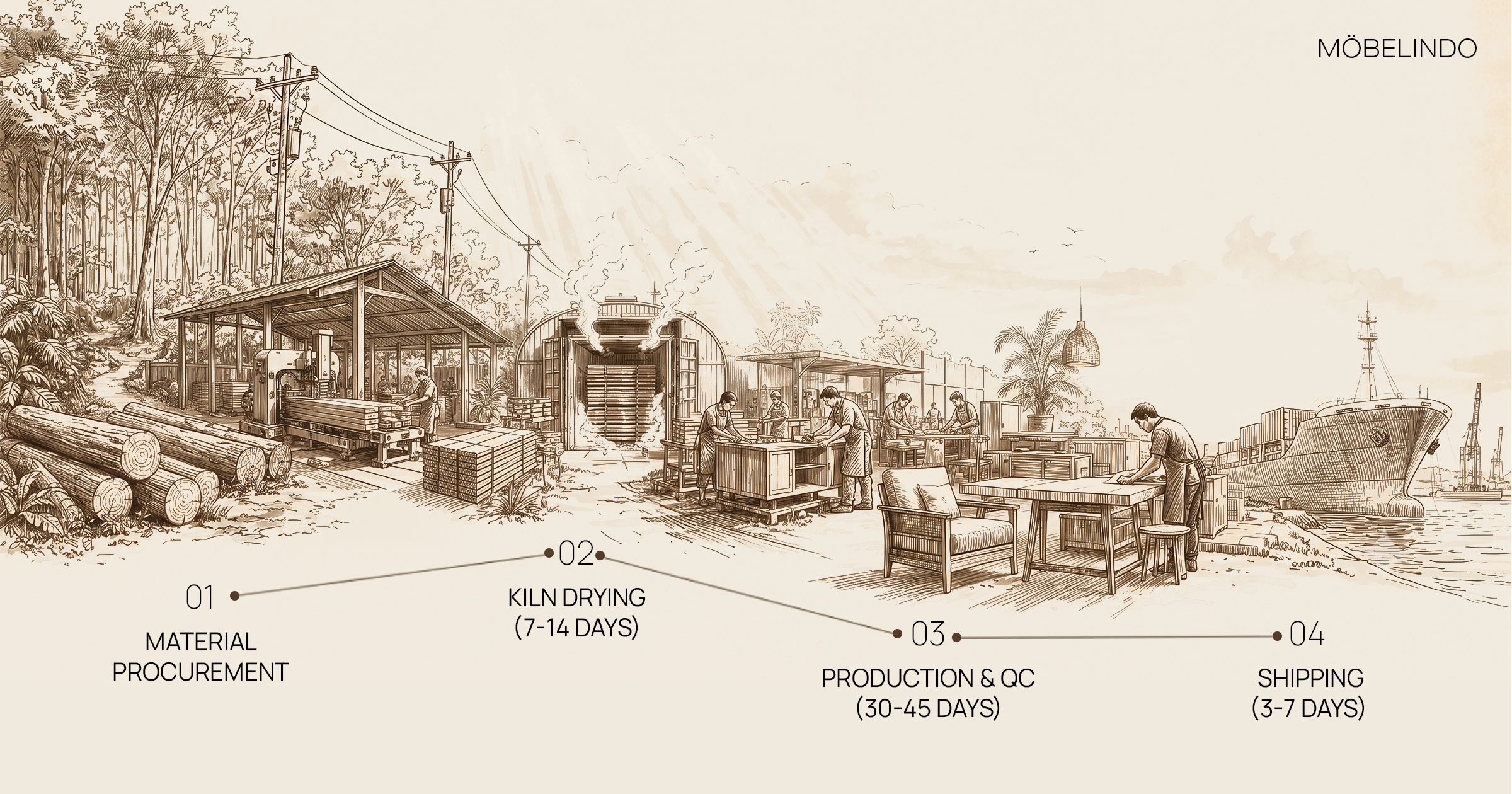
That total breaks into four component windows that behave differently. Kiln drying and material preparation runs 7 to 14 days per batch. Production and finishing runs 6 to 10 weeks. QC and rework buffer runs 5 to 7 days. Container scheduling and shipping documentation runs 7 to 14 days plus 3 to 6 weeks of ocean transit depending on destination.
The reason procurement teams should ask for the component breakdown rather than a single number is straightforward. Single-number quotes hide risk. A supplier who says “12 weeks” can mean 12 weeks if everything goes perfectly, or 12 weeks with a hidden buffer that gets consumed by the first missed milestone. A supplier who says “7 to 14 days kiln, 6 to 10 weeks production, 5 to 7 days QC, 7 to 14 days documentation, plus freight” is telling you where the flex points are and where they are not.
The flex points matter because most lead time delays do not come from production speed. They come from misjudged component windows early in the schedule, particularly kiln drying and QC buffer, which are the two areas where inexperienced suppliers most often overpromise.
Why does kiln drying take 7 to 14 days for hospitality-grade teak?
Kiln drying for hospitality-grade teak takes 7 to 14 days per batch because the drying schedule has to bring the wood down to a specific moisture content target without inducing internal stress that surfaces months later.
The target moisture content depends on the destination climate. For tropical hospitality projects (Southeast Asia, Middle East coastal, Caribbean), the target is typically 10 to 12 percent. For temperate destinations (Europe, North America), the target is typically 8 to 10 percent. Missing the target by more than 2 percent in either direction is where you see field problems: doors that stick in humid seasons, panels that cup after installation, joints that loosen over the first year.
Three variables extend the drying window. Thickness of the boards matters directly. A 2cm board dries in roughly half the time of a 5cm structural board, but hospitality orders usually contain both, so the batch runs to the slowest component. Species matters too. Teak dries slower than mahogany or acacia because of its natural oil content. And kiln capacity in most Jepara workshops runs on batch cycles, so an order that arrives during an active drying cycle waits for the current batch to complete.
The shortcut that some suppliers take is running the kiln hotter to compress the schedule. This produces wood that reads as dry on the moisture meter at the workshop but carries case-hardening, which is internal stress that releases weeks or months later. The furniture arrives at the property, sits in the destination climate for three months, and starts moving. By then the container has been paid for and the supplier is on the next project.
A supplier who quotes 5 days for kiln drying on a mixed-thickness hospitality order is either not doing the drying properly or not telling you what they are actually doing.
How long does production take after wood is dried?
Production from dried wood to packaged pieces typically takes 6 to 10 weeks depending on order complexity, breaking down into machining and joinery, assembly, sanding, multi-coat finishing with drying time between coats, hardware installation, and packing preparation.
The largest single variable is the finish system. A water-based interior coating with two coats and light sanding between coats takes roughly 10 to 14 days from first coat to packing-ready. A multi-layer oil finish system for indoor and outdoor pieces takes 18 to 25 days for the same volume, because oil finishes need longer between coats and demand more environmental control (temperature, humidity, dust) during drying.
The second largest variable is joinery complexity. Simple butt joints with modern hardware move fast. Traditional mortise-and-tenon joinery, dovetail drawer construction, or hand-fitted panel work moves slower. A boutique specification that reads “solid teak wardrobe with traditional joinery” costs meaningfully more production time than one that reads “solid teak wardrobe with contemporary construction,” even though the finished pieces may look similar to a non-technical observer.
The third variable is design revision cycles during production. Every reasonable boutique project has some in-flight adjustments. A supplier whose workflow can absorb reasonable revisions without stopping other lines maintains schedule. A supplier whose workflow treats every revision as a full production restart falls behind.
For procurement teams building the schedule, a useful rule is that production time compresses less easily than any other component. Kiln drying is somewhat compressible with better planning. Documentation is compressible with parallelization. Production speed is fundamentally constrained by the material’s physics.
Why does the QC and rework window add 5 to 7 days?
The QC and rework window adds 5 to 7 days because every serious hospitality shipment includes a final inspection round where any flagged items go back to the workshop for correction before container loading.
The inspection can be client-side (procurement team visits) or third-party (ITS, SGS, Bureau Veritas, or another international inspection body). For international boutique projects, third-party inspection is common because it produces documented findings that both parties can reference. The inspection typically covers dimensional accuracy against specifications, finish quality against approved samples, hardware installation, joinery integrity, packing standard, and cross-check against the packing list.
The rework portion of the window is where the discipline of the supplier shows. Inspections almost always flag some items. A touch-up finish repair, a hardware alignment issue, a missing labelling detail. A workshop with real production discipline absorbs these corrections in the buffer window and ships on schedule. A workshop that hopes the inspection will find nothing gets caught when the inspection finds something.
The common mistake is suppliers who do not budget for rework in their quoted lead time. They either ship the defects (which creates installation problems at the property, worse) or they delay shipment beyond the quoted date (which creates schedule problems for the buyer, also bad). A supplier who quotes 12 weeks total with no visible QC buffer is telling you they either have not thought about rework or they are not planning to allow time for it.
For procurement teams, the QC buffer is worth protecting even if it means asking the supplier to add a week to their quote. A quoted schedule that consumes the buffer is not a real buffer.
How long does container scheduling and shipping documentation take?
Container scheduling and shipping documentation typically adds 7 to 14 days between production completion and container departure, plus 3 to 6 weeks of ocean transit depending on destination and current shipping conditions.
The pre-loading window covers several parallel workflows. Container reservation with the freight forwarder, which needs to lock in a specific vessel and departure date. Loading window scheduling at the supplier’s yard or at the port stuffing facility. Documentation preparation, which includes commercial invoice, detailed packing list, SVLK legality documentation for timber, fumigation certificates for wooden crates, country of origin declarations, and any destination-specific certifications the buyer’s customs broker has flagged. For EU-destination shipments after 30 December 2026, EUDR-compliant Due Diligence Statements will be part of the required package.
Ocean transit varies significantly by destination. Regional Asian ports (Singapore, Kuala Lumpur, Manila) run 2 to 3 weeks from Semarang or Surabaya. Middle Eastern ports (Jebel Ali, Dammam) run 3 to 4 weeks. Australian ports run 3 to 4 weeks. North American West Coast ports run 4 to 5 weeks, East Coast 5 to 6 weeks. European ports run 4 to 6 weeks. Add customs clearance at destination (3 to 7 days for hospitality FF&E in most markets, longer if documentation gaps trigger inspection).
The compression opportunity in this window is documentation parallelization. A disciplined supplier prepares SVLK documentation, EUDR paperwork, and packing lists during the production phase, not after production completes. This can shave 3 to 5 days off the total lead time without changing anything about production or shipping. Suppliers who prepare all documentation after production completes are not saving anything, they are just delaying the shipment.
How can I compress lead time without compromising quality?
Three legitimate compression strategies work reliably: front-loading sample approvals, staged production releases, and parallelizing documentation with production. Strategies that shortcut kiln drying, QC buffer, or finish drying time are not compression, they are risk transfer to the buyer.
Front-loading sample approvals compresses the total project timeline by moving sample rounds outside the production window. If sample approval happens during specification development rather than after PO, the supplier can begin kiln drying material immediately upon PO confirmation. This typically saves 4 to 6 weeks off the front end of the schedule.
Staged production releases compresses installation-critical items. Release production for guest room casegoods first (which are typically the earliest installation priority) and public area furniture second. The property can begin installation on the first shipment while the second is still in production. This works when the property construction schedule can absorb multiple delivery windows.
Parallelizing documentation with production compresses the pre-loading window by preparing SVLK, EUDR, and packing documentation during production rather than after. This is entirely within the supplier’s control and typically saves 3 to 5 days. A supplier who is not doing this by default is optimizing for their internal workflow rather than for the buyer’s schedule.
The strategies that do not work, even though some suppliers offer them, include shortening kiln drying schedules (produces field defects), skipping intermediate QC (ships defects), reducing finish drying time between coats (finish fails within 6 to 12 months of installation), and eliminating rework buffer (ships problems). Every one of these creates a problem that surfaces at the property, usually within the first year of operation, and usually attributed to the manufacturer regardless of the schedule pressure that caused it.
A Five-Question Checklist for Your Next Supplier Conversation
Before you finalize any hospitality furniture supplier for a schedule-critical project, ask these five questions and note whether the answers include specific windows.
One: Can you break your quoted lead time into components (kiln drying, production, QC, documentation, freight)? A supplier who quotes only a total number is either not tracking the components or not willing to expose the flex points.
Two: What moisture content target do you use for our destination, and what is your kiln schedule for our batch? A supplier who cannot answer this specifically is not thinking about your destination climate.
Three: What finish system will you use, how many coats, and what is your drying time between coats? A supplier who compresses this is setting up finish failure within the first year.
Four: How much QC and rework buffer is built into your quoted lead time? A supplier with no visible buffer is either hoping for perfect inspection results or planning to ship defects.
Five: When do you prepare export documentation relative to production completion? A supplier who prepares documentation after production completes is adding avoidable days to your schedule.
A Closing Note
Lead time in Indonesian hospitality furniture procurement is not a single number. It is a stack of interdependent windows, each with its own physics and its own honest range. The suppliers who deliver on schedule over multiple projects are the ones who quote all four components openly and defend each one against pressure to compress it improperly.
If you are working backward from an opening date and want to talk through your specific schedule, my DMs are open. No pitch, no obligation. Just a conversation with someone who has been on the manufacturer side of these decisions for a while.


0 Comments