





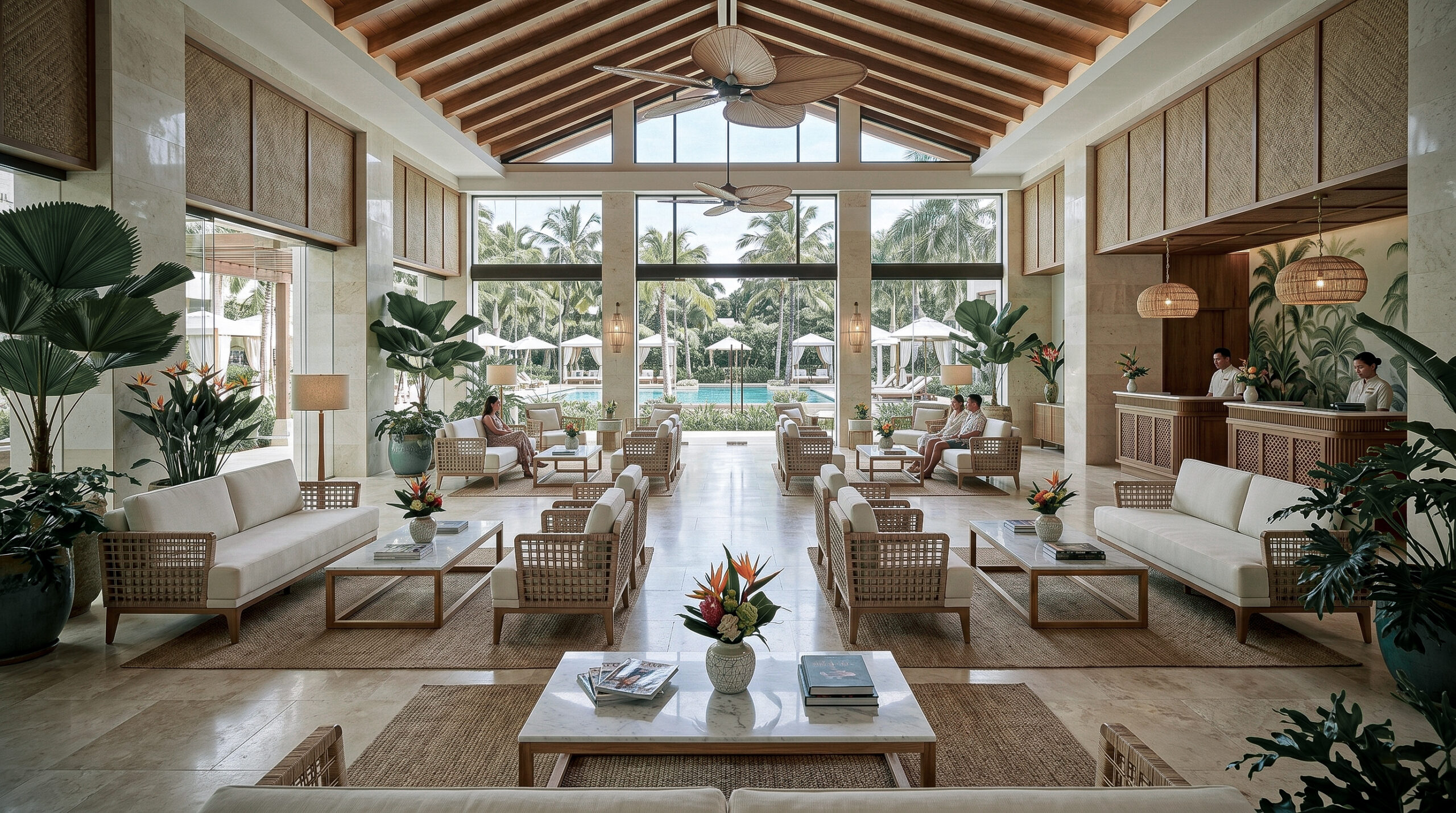
A practical Q&A for hospitality FF&E procurement teams.
Someone asked me this question for the third time this month, so I finally sat down to write it up properly. What follows is a Q&A for hospitality procurement teams evaluating Jepara-based furniture suppliers for boutique hotel, resort, and villa projects. It is structured for quick reference, but written the way I would actually answer over coffee.
What is Jepara furniture and why does it matter for hospitality projects?
Jepara is a district on the northern coast of Central Java, Indonesia, that has been the country’s primary center of solid wood furniture craftsmanship for several centuries. Its relevance to hospitality projects comes down to three factors: workshop density, generational skill transfer, and an integrated production ecosystem.
The district contains thousands of workshops of varying sizes, from single-family operations to organized workshop networks. This density creates a labor market of skilled woodworkers, finishers, and joinery specialists that is difficult to replicate elsewhere in Indonesia or in the region. Skills pass through family and apprenticeship structures that go back multiple generations, which is why the technical vocabulary of Jepara craftsmanship (specific joinery methods, finishing techniques, timber grading) is often more refined than what you find in newer manufacturing centers.
The supporting ecosystem matters as much as the workshops themselves. Timber suppliers, hardware wholesalers, packaging specialists, and freight consolidators all operate within Jepara or nearby cities. A supplier based in Jepara has faster access to inputs, more competitive pricing on materials, and shorter internal logistics than a supplier of equivalent scale located elsewhere.
For hospitality projects specifically, Jepara’s specialization in solid teak, mahogany, and rattan aligns closely with what boutique hotels, resorts, and villa developments tend to specify. The district has served hospitality FF&E orders for decades, which means many suppliers have institutional knowledge of the documentation, packing standards, and quality expectations that international hospitality projects require.
One caveat worth noting. Not every supplier that claims to be “from Jepara” is actually based there. Some trading companies market Jepara heritage but subcontract production to workshops in other regions with lower cost bases. Verification matters, which is covered in a later section.
What should I ask a Jepara furniture supplier before requesting a quote?
Before an RFQ goes out, five questions surface the difference between suppliers worth qualifying further and suppliers worth politely declining.
First: Where is your production physically located, and do you own or operate the workshop? A supplier who cannot answer this concretely, with a specific address and a clear organizational relationship to the workshop, is a trading intermediary rather than a maker. Both models have their place, but the pricing, quality control, and lead time implications are different.
Second: What is your timber source? For solid teak, the credible answers are Perhutani plantation stock from Java, or documented reclaimed teak from verified sources. Vague answers about “local suppliers” are a signal to dig deeper before proceeding.
Third: What is your standard sample process, and what does it cost? Sample capability and honesty about sample costs indicate a supplier’s operational maturity. Suppliers who offer free samples on every project are either bluffing or building the cost into inflated unit pricing later.
Fourth: How do you handle Customer’s Own Material inputs? For boutique hospitality projects, COM fabric and hardware handling is a routine requirement. A supplier who treats COM as an unusual request is signaling limited hospitality project experience.
Fifth: Can you share reference projects at similar scale to ours, with details? Specific answers with quantities, project types, and lessons learned indicate real project history. Generic “we have worked with many hotel brands” answers indicate the opposite.
These five questions cost nothing to ask and take about fifteen minutes of a supplier’s time to answer thoughtfully. A supplier who cannot make time for this conversation is not ready to serve a hospitality project regardless of what their catalogue looks like.
How long is the typical lead time for hospitality furniture from Jepara?
For a one-container boutique hospitality order, the total lead time from purchase order to on-site delivery is typically four to six months, depending on destination.
The internal breakdown for a serious Jepara supplier looks approximately like this. Timber reservation and kiln drying takes 14 to 21 days per batch. Machining and assembly takes 6 to 10 weeks depending on order complexity and workshop capacity. Finishing takes 2 to 4 weeks depending on the number of coats and drying time between coats. QC inspection plus packing and container loading takes 1 to 2 weeks.
That gets you from PO to loaded container in roughly 12 to 16 weeks. Ocean freight adds another 4 to 6 weeks for the United States and Europe, 3 to 4 weeks for the Middle East and Australia, and 2 to 3 weeks for regional Asian destinations. Add customs clearance and inland trucking at the destination, and you arrive at the total four to six month range.
Two adjustments worth planning for. Sample rounds add time on the front end, typically 4 to 8 weeks for a complete sample cycle including revisions and approvals. And peak season loading, particularly in the months before Chinese New Year and around Indonesian Idul Fitri holidays, can compress workshop capacity and add 2 to 4 weeks to production timelines.
Suppliers who quote lead times without breaking them down into these components are giving you estimates rather than commitments. Suppliers who can walk you through each stage are showing you the production floor discipline that lets them actually meet the commitment.
What documentation should I request from a Jepara supplier?
For a hospitality FF&E order from Jepara, the documentation package should cover four categories: business legitimacy, material sourcing, production quality, and export compliance.
Business legitimacy documents include the supplier’s Nomor Induk Berusaha (Indonesian business registration number), tax registration, and if applicable, industry association memberships such as HIMKI (the Indonesian Furniture and Handicraft Industry Association). These confirm the supplier is a formally registered entity rather than an informal operator.
Material sourcing documentation includes timber source records, ideally Perhutani chain-of-custody paperwork for plantation teak. For EU-destination shipments after 30 December 2026, EUDR-compliant Due Diligence Statements will be mandatory across the supply chain.
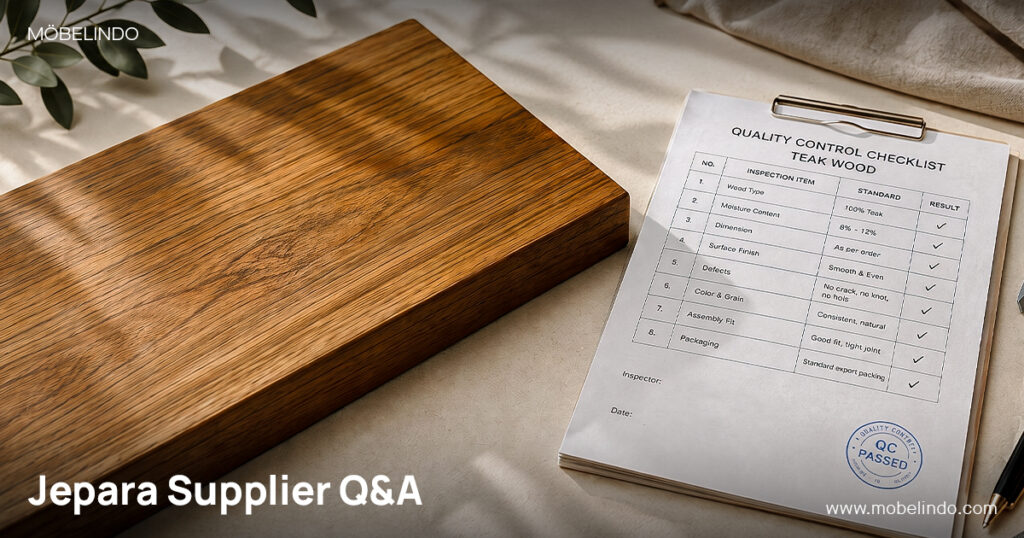
Production quality documentation includes sample approval records signed by both parties, kiln drying records with moisture content readings, QC inspection reports at intermediate and final production stages, and photographic documentation of key production milestones.
Export compliance documentation includes SVLK (Indonesian timber legality) documentation for every export shipment, packing lists that match commercial invoices at the unit level, fumigation certificates for wooden crates, country of origin declarations, and any destination-specific certifications required.
A supplier who can produce these documents at each stage of the project, rather than assembling them retroactively when the container is ready to ship, is a supplier whose production process is disciplined. Documentation is a symptom of process quality, not a substitute for it.
How do I verify a Jepara supplier without visiting the workshop?
Site visits remain the strongest verification method, but they are not always feasible for early-stage supplier evaluation. Five verification methods work reasonably well without travel.
Video call from the workshop, not from the office. Ask the supplier to take you on a live video walkthrough of the workshop, showing the current work in progress, the drying kilns, the finishing area, and the packing zone. Suppliers with real production capacity can do this on short notice. Trading intermediaries usually cannot.
Geographic verification. Ask for the workshop’s GPS coordinates and cross-reference against satellite imagery on Google Maps. The image should show a genuine industrial building or workshop compound, not a residential address or a shophouse.
Reference calls with past clients. A supplier should be willing to connect you with at least one or two past clients on projects of comparable scope. Follow through on these calls. Ask specific questions about lead time performance, documentation quality, and how the supplier handled changes during the project.
Industry association verification. HIMKI membership is verifiable through the association’s public directory. SVLK export documentation is traceable through the Sistem Informasi Legalitas Kayu database operated by the Indonesian Ministry of Environment and Forestry.
Sample project as pre-qualification. For higher-value projects, commissioning a small sample order (one or two pieces) as a paid pre-qualification test is often worthwhile. The way a supplier handles a small order is a reasonable proxy for how they will handle a large one.
None of these methods replaces a site visit for a major project commitment, but together they build enough confidence to proceed to the site visit stage with a shortened list of qualified candidates.
What is the difference between a Jepara workshop and a large-scale factory model?
Jepara operates two dominant production models, workshop-based and factory-based. Both can serve hospitality projects well, but they serve different scales and profiles.
The workshop model typically involves 30 to 100 workers per production unit, with strong craftsmanship depth and flexibility in handling design variations, small production runs, and detailed custom specifications. Workshop-based suppliers tend to be well-suited to boutique hospitality projects of one to three containers per order, where design variety matters more than volume efficiency.
The factory model typically involves 200 or more workers under one roof, with standardized production lines optimized for high-volume repetitive output. Factory-based suppliers tend to serve hotel chain orders of five containers or more per project, where consistency across large volumes matters more than design flexibility.
A third model, less commonly discussed but increasingly relevant, is the coordinated workshop network. This model involves a lead manufacturer coordinating multiple partner workshops under a unified quality control and project management structure. It offers the craftsmanship depth of the workshop model at the capacity of a larger factory, without the fixed overhead that factory-model suppliers carry. For boutique hospitality projects at the two to five container range, this hybrid model often produces the best balance of quality, flexibility, and price.
The relevant question for procurement teams is not which model is superior in the abstract, but which model matches the scale and design profile of your specific project. A single container of boutique guest room casegoods with heavy custom detail is a workshop project. A ten container order for a 300 room chain hotel with standardized specifications is a factory project. Most projects sit somewhere in between, and the coordinated network model tends to serve that middle ground best.
Three Practical Next Steps for Procurement Teams
If you are actively evaluating Jepara furniture suppliers for a hospitality project, three concrete actions turn this article from reading into progress.
Draft your supplier qualification checklist. Take the five questions in the second section of this article, add the documentation categories from the fourth section, and turn them into a written qualification checklist. Suppliers who cannot pass the checklist do not proceed to RFQ stage. This filters your candidate pool before you invest time in detailed RFQ evaluation.
Structure your RFQ around production math, not just pricing. Ask suppliers to break down their lead time commitments into the component stages (kiln drying, production, finishing, QC, packing, freight). The transparency of their answer is diagnostic. Suppliers who can articulate the production math are usually the ones who can meet it.
Plan your verification sequence before the RFQ closes. Decide in advance which verification methods you will apply to shortlisted suppliers (video walkthrough, GPS check, reference calls, HIMKI verification, sample pre-qualification). Sequencing this at the RFQ stage rather than after selection saves significant time later and avoids the pattern of discovering supplier gaps after purchase orders have been issued.
A Closing Note
Evaluating Jepara furniture suppliers is, at its heart, a due diligence process rather than a comparison shopping process. The suppliers who serve hospitality projects well over multiple engagements share a common profile. They document their process. They answer specific questions with specific answers. They treat procurement teams as long-term partners rather than transactional buyers.
If you are working through supplier evaluation for a specific hospitality project and want to talk through your specification requirements, my DMs are open. No pitch, no obligation. Just a conversation with someone who has been on the manufacturer side of these decisions for a while.


0 Comments